Turn every response into an opportunity to improve.
ResponseStandard brings CAD data, radio traffic, operational tasks and incident information together into one clear timeline — so your department can see what happened, reinforce what worked, and find the opportunities to improve.
- →Basic incident review is free.
- →No CAD integration required to begin.
- →No RMS replacement required.
For demonstration — not an official record.
01The problem
Your department responds to thousands of incidents.
How many of them actually get reviewed?
The significant fires usually get the attention. But there are lessons in the automatic alarm, the gas leak, the hazmat call, the adaptive response and the operation that went sideways for reasons nobody wrote down.
Departments already hold the information. Reviewing it takes time, because the CAD data, the radio traffic, the narratives, the photos and what people remember all live in different places.
02The problem
The fire is over in an hour. The review takes a week.
What happened survives in pieces — audio, CAD timestamps, video, photos and narratives written days later.
Someone has to find all of it and line it up by hand, after shift — for every response worth reviewing.


You didn’t take the job to assemble paperwork.
The hours go into matching radio traffic to timestamps instead of into the conversation with the crew.
We do the assembly. You do the teaching.
03Fire service operational intelligence
Turn the information you already have into something you can learn from.
Your department sets the standard. ResponseStandard organizes what actually happened — the CAD data, the radio traffic and the operational tasks — so an incident can answer four questions instead of one.

The goal isn’t to find fault. The goal is to get better.
Three steps. That’s the whole platform.
Upload the incident. Get the review back.

Upload
Bring the incident together.
Enter your CAD times by hand or upload them — no integration required to begin.
- →Call received, call answered, dispatched, en route, on scene, clear scene
- →Dispatch and fireground audio (WAV, MP3, M4A, AAC, OGG)
- →Video and scene photos
- →Select the incident type being reviewed
Operational tasks are preconfigured and ready to review against the incident.

Review
See the incident unfold.
Radio traffic is transcribed and lined up against your CAD timestamps, with the operational tasks for that incident type ready to review.
- →Every transmission transcribed and placed on the clock
- →CAD milestones and radio traffic on one timeline
- →Tasks timestamped from the transcript where the evidence exists
- →Anything not said on the radio, you add yourself
AI finds what it can. Your officers complete the story.
Improve
Turn the incident into a lesson.
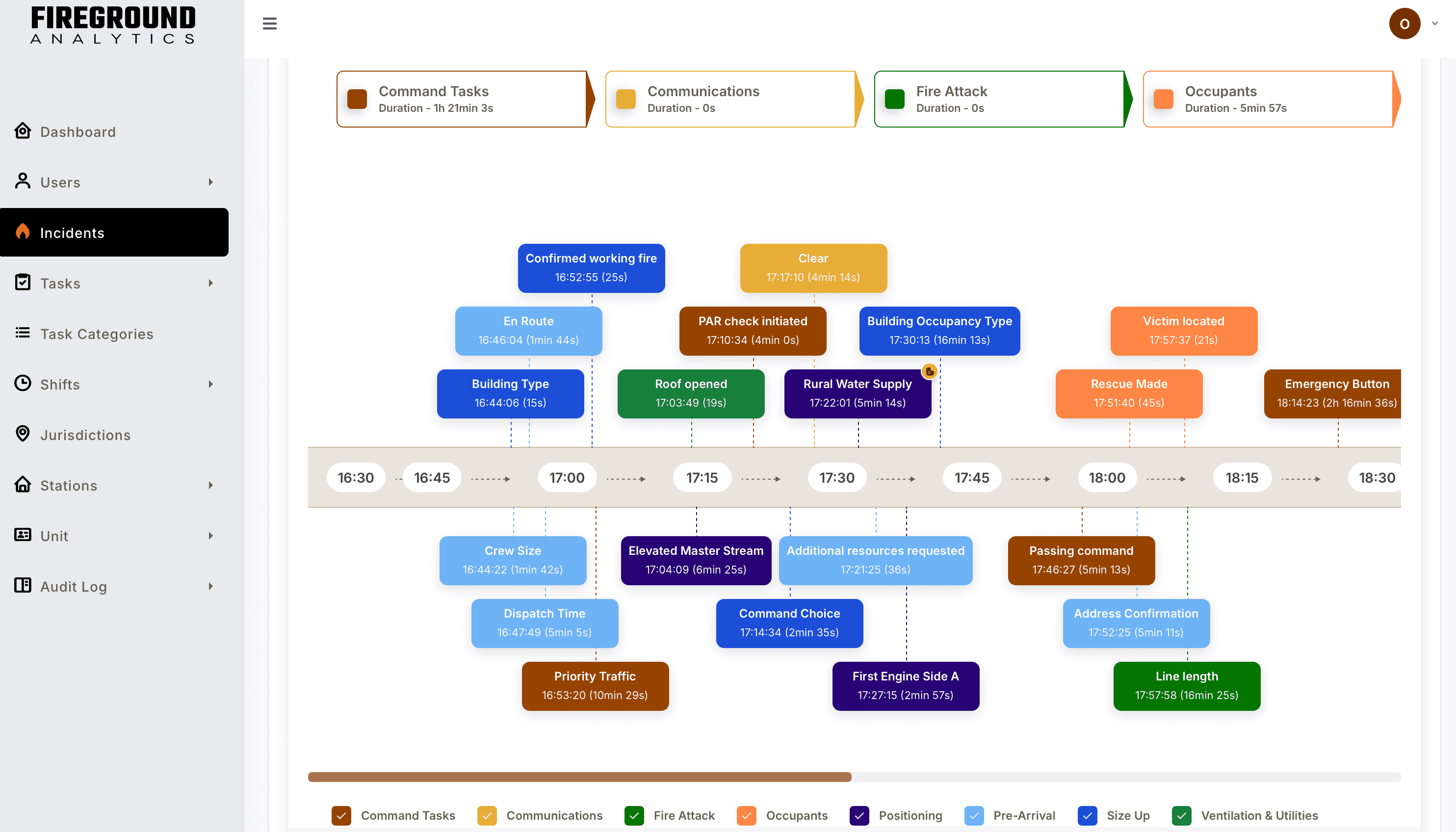
One chronological operational picture — CAD events, radio communications and operational tasks together.
- →Run the after-action review with the timeline on screen
- →Reinforce the performance that worked
- →Review operational benchmarks and policy alignment
- →Identify training opportunities and compare incidents over time
Here's what happened. Now use it to get better.
Basic incident review is free. No integration required to begin.
05What you receive
One incident. One chronological picture.
CAD events, radio communications and operational tasks on a single clock. The output is not a transcript — it is an operational picture of the response.
See the incident unfold.
Then turn it into a lesson.
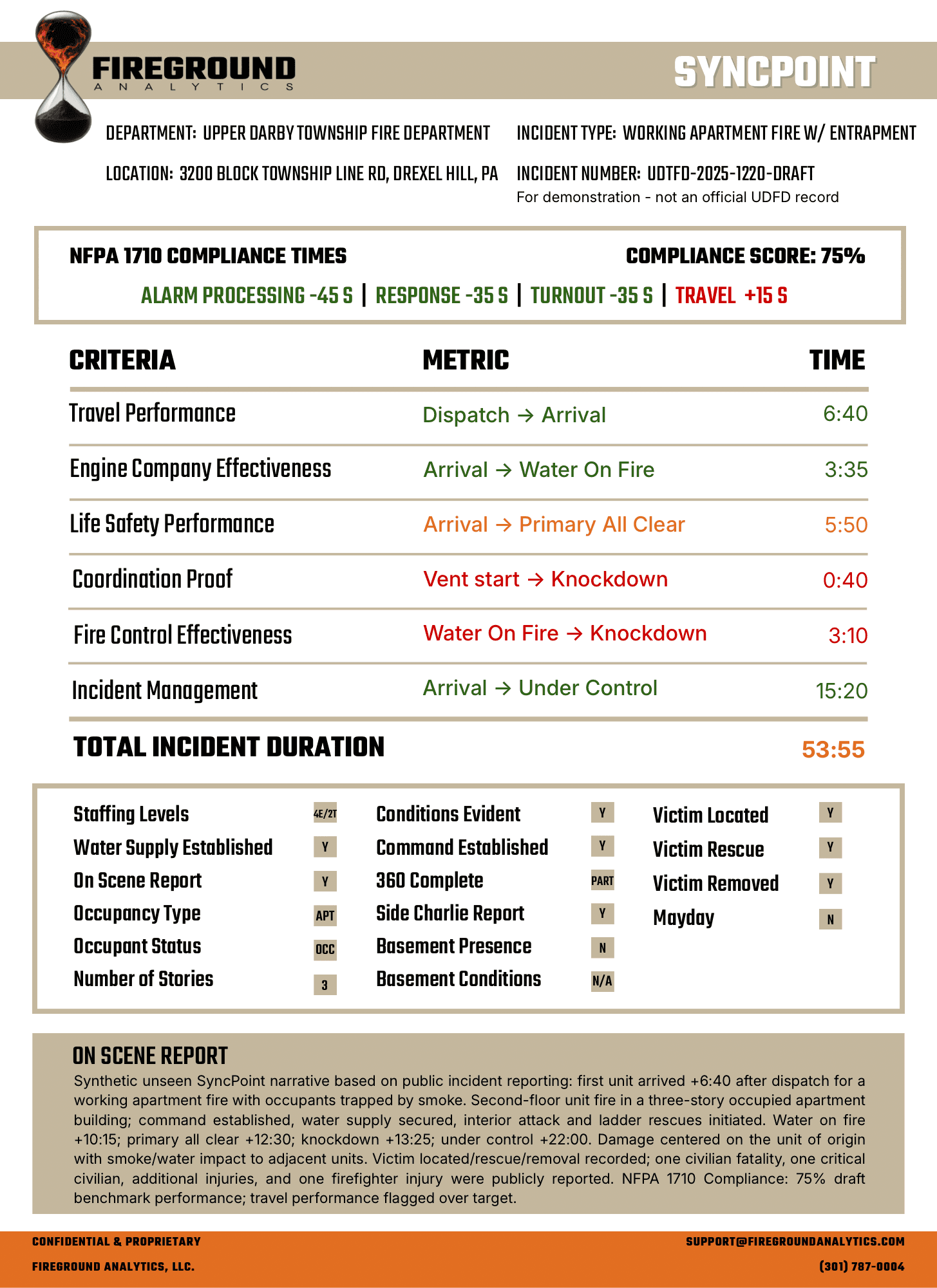
Each criterion is measured between two timestamped events on that timeline.
The times come from the record of the incident rather than from recollection, which is what makes them usable in a room full of the people who were there.
This sheet measures against NFPA 1710 criteria. Where you have configured your own expectations, the review can speak to those instead.
06What it costs
Start reviewing incidents for free.
Not a trial. Not one free incident. Basic operational review is free, so cost is never the reason a response goes unreviewed.
Request a DemoRequest access to get started. Self-service signup is being finished now — until it opens, we set departments up directly.
- Department and user accounts
- Manual CAD entry or upload
- Incident audio upload
- Radio traffic transcription
- Incident-type selection
- Preconfigured operational-task framework
- Task timestamping
- Manual task additions
- One unified incident timeline
- Basic operational review
- Incident review history
07Going further
Want it to do more?
The free review stands on its own. These are optional capabilities for departments that want the system to measure against their own policies, do the gathering for them, or show them the pattern across hundreds of responses.
SOP & SOG comparison
Add your own SOPs, SOGs, operational manuals and performance expectations. The review can then speak to one question: did this incident align with what we say should happen?
- →Alignment with your own expectations
- →Deviations worth reviewing
- →Training opportunities
- →Recurring trends
CAD, RMS & audio integration
The free product works from files you upload by hand. Integration is how departments stop doing that work — selecting the incident types they want reviewed, so qualifying responses start a review on their own.
- →CAD and RMS connections
- →Radio and audio sources
- →Automatic review on selected incident types
Organizational intelligence
One incident tells a story. Hundreds reveal a pattern — what you are doing well, where you are drifting, and what to train on next.
- →Response-time and task-completion trends
- →Recurring operational delays
- →Communication patterns
- →Performance by incident type
- →Department dashboards
Your department stays the tactical authority. Where you add your own SOPs and SOGs, the review answers one question — did this incident align with what we say should happen? — and nothing about what we think should have happened.
08What changes
What if every response became tomorrow’s training?
Fewer hours on the report. More responses reviewed.
The review is ready the same shift, while the incident is still fresh.
09Who you become
From reconstructing the incident to learning from it.
“I think I know what happened.”
- CAD somewhere.
- Radio somewhere.
- Narrative somewhere.
- Photos elsewhere.
- Different recollections.
“I can see what happened.”
One chronological operational picture — CAD events, radio communications and operational tasks together, each anchored to where it came from.
The conversation stops being about what happened, and starts being about what to do better.
10Security & data handling
Easy to adopt. Safe to use.
You upload the files you choose. Fireground Analytics never touches your CAD or RMS.

11Research & training
Learn from the research. Learn from the data. Learn from the fireground.
The fire service already has powerful research and real-world data about operational performance. We help departments apply that same learning mindset to their own responses.
Measuring Fireground Performance: An App-Driven Approach to Reducing Operational Gaps
Research examining structured fireground performance measurement — time- and task-based metrics, operational data, and how departments use them to close operational gaps.
Read the researchFirefighter Rescue Survey
Data collected from actual rescues to help the fire service understand what successful rescue operations look like, and inform how departments train for them.
Explore the dataFirefighter Mayday Survey
A data-driven effort to objectively collect and analyze firefighter Mayday experiences, and share what they teach back to the fire service.
Explore the dataFire Safety Research Institute
Research, training and science-based fire safety information for the fire service and the public.
Visit FSRIIndependent resources are provided for fire-service education and professional development. Inclusion does not imply affiliation with or endorsement of Fireground Analytics.
The Educated Firefighter
Free fireground video breakdowns — real incidents used to talk through tactics, positioning, decision-making, fire behavior and the operational lessons underneath them.
What we believe
We measure almost everything.
- Response times
- Turnout times
- Staffing
- Apparatus
- Call volume
Why wouldn’t we learn from our responses?
Incident review shouldn’t only happen after something goes wrong. Waiting for failure means the only lessons a department collects are expensive ones.
Good incidents deserve to be studied too.
- →Reinforces the training that worked
- →Validates effective practice
- →Creates repeatable success
The goal isn’t to find fault.
The goal is to get better.
Your next response is going to happen.
Make sure you learn from it.
When time is the enemy, data is the solution.